Needing some feedback

I apologize for the length, but I'm wanting all the help I can get. I will include my set up at the bottom.
I'm new to VO work as well as the audio tech side of this business. So every day I'm learning a little more of what quality VO sounds like. I applied to VoiceBunny, got rejected and got some feedback which is exactly what I wanted.
This was my original submission with the feedback of the rejection:
https://soundcloud.com/andy-axne/voice-bunny-audition/s-5P44n?in=andy-axne/sets/voicebunny/s-c5ftN
1) Your deliverable is not normalized to the -3dBFS peak level our clients prefer. Remember to always normalize your files before submitting them.
2) Your enunciation of hard consonants is causing air to hit the microphone\'s capsule, which translates as audible \'pops\' or plosives. This issue can be resolved with the adjustment of the mic\'s position, use of pop filter and a proper distance from the mic.
3) Loud background noise is impacting your recording and adversely affecting the quality of the deliverable. Some of those are mouse clicks after the phrases, you should manually edit those out.
Here's my edited track addressing those 3 points. I should note that I did not redo the audition, but worked on the editing in the DAW so that I could have a better ear to hear what was wrong with the original audition. Please critique so that I can refine my skills even more.
https://soundcloud.com/andy-axne/voice-bunny-audition-edited-1/s-X4sm1
1) I watched some videos to learn how to normalize the track, but I'm not sure exactly what the whole track is suppose to sound like when the peak is suppose to be -3dBFS. I assume that the highest points can touch the -3db, but do the softer parts also need to stay at a -3db range?
2) I use a pop filter, but I appreciate the comments about mic position and distance from mic. I'll apply those tips to further projects. For this editing of this audition, I focus on learning how to edit out the pops and plosives. I felt like I did a fairly good job, but there were one points I felt like I couldn't edit out. Let me know if there was more I could've done:
- 23 sec "Take Part"
3) Lastly, this point was probably the most time consuming in learning about what the sound was, and then learning how to edit it out. I still don't know fully what causes all of the clicks nor how to edit the ones that are in the middle of a word. I presume I'd just have to redo those words/phrases that I'm unable to edit. The feedback said "mouse clicks", but my assumption is that those were "mouth clicks"? I tried editing those out as much as I could, but I found some others that I don't know how I'd edit out. Also, I'm just listing this out to confirm if what I'm hearing is true according to the feedback. Please keep in mind that I'm new so there are some things that I just don't know. Here are other points where I heard the click, but couldn't edit:
- 1 sec "Voiceovers were"
- 19 sec "Into your home"
- 23 sec "Counting on you to take"
- 30 sec "To stay"
I think that covers the feedback. Thank you for reading! Here's a list with some pictures of my "studio":
- FiFine K670
- Aokeo Professional Microphone Pop Filter Mask Shield
- Neweer adjustable mic arm
- Asus Laptop
2) DAW
- Reaper (Free version)
- No Compression, No EQ. Only gate up to -44db
- Closet about 2 ft deep and 4 ft wide
- 2 Moving blankets used to absorb sound
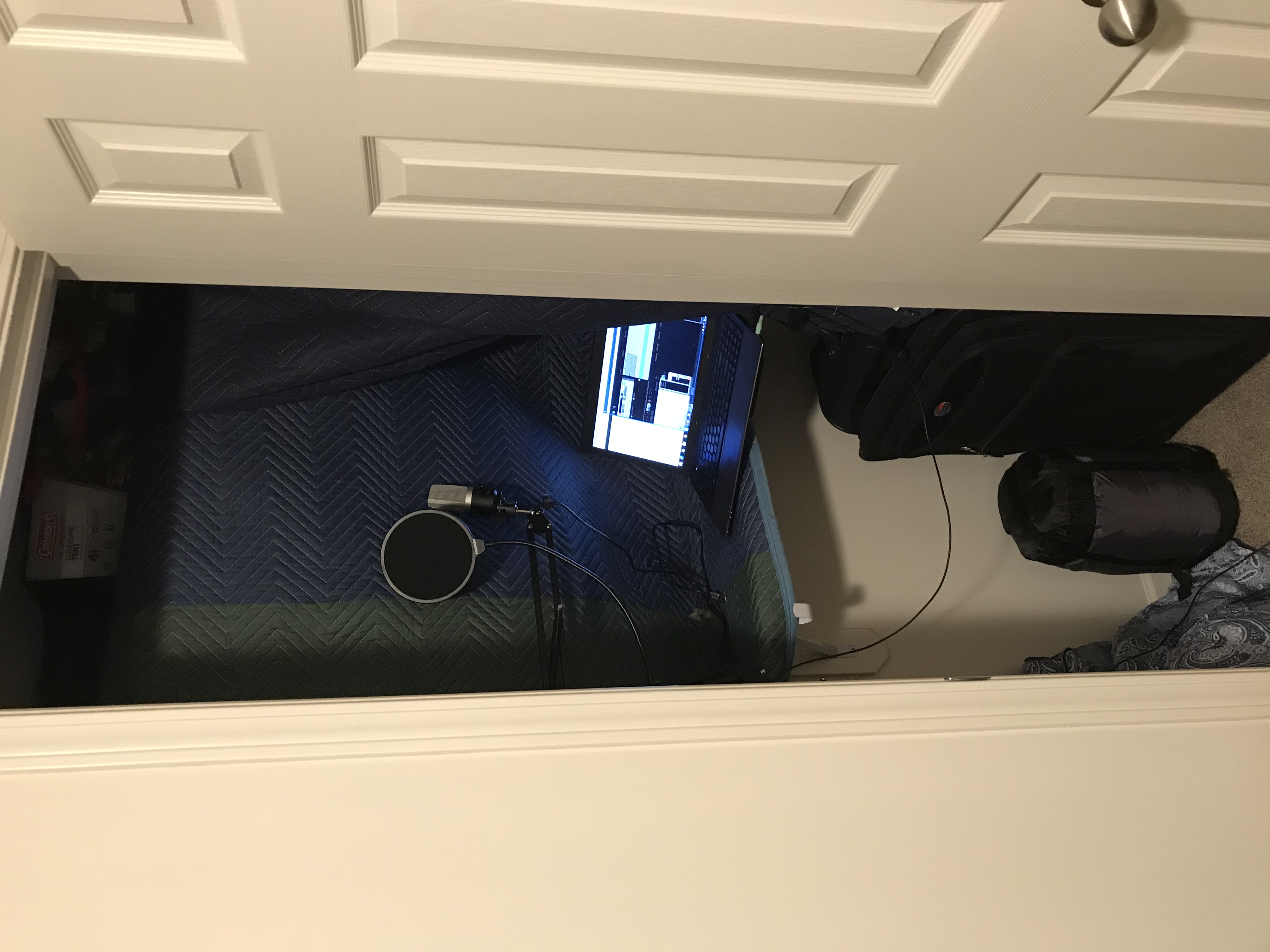
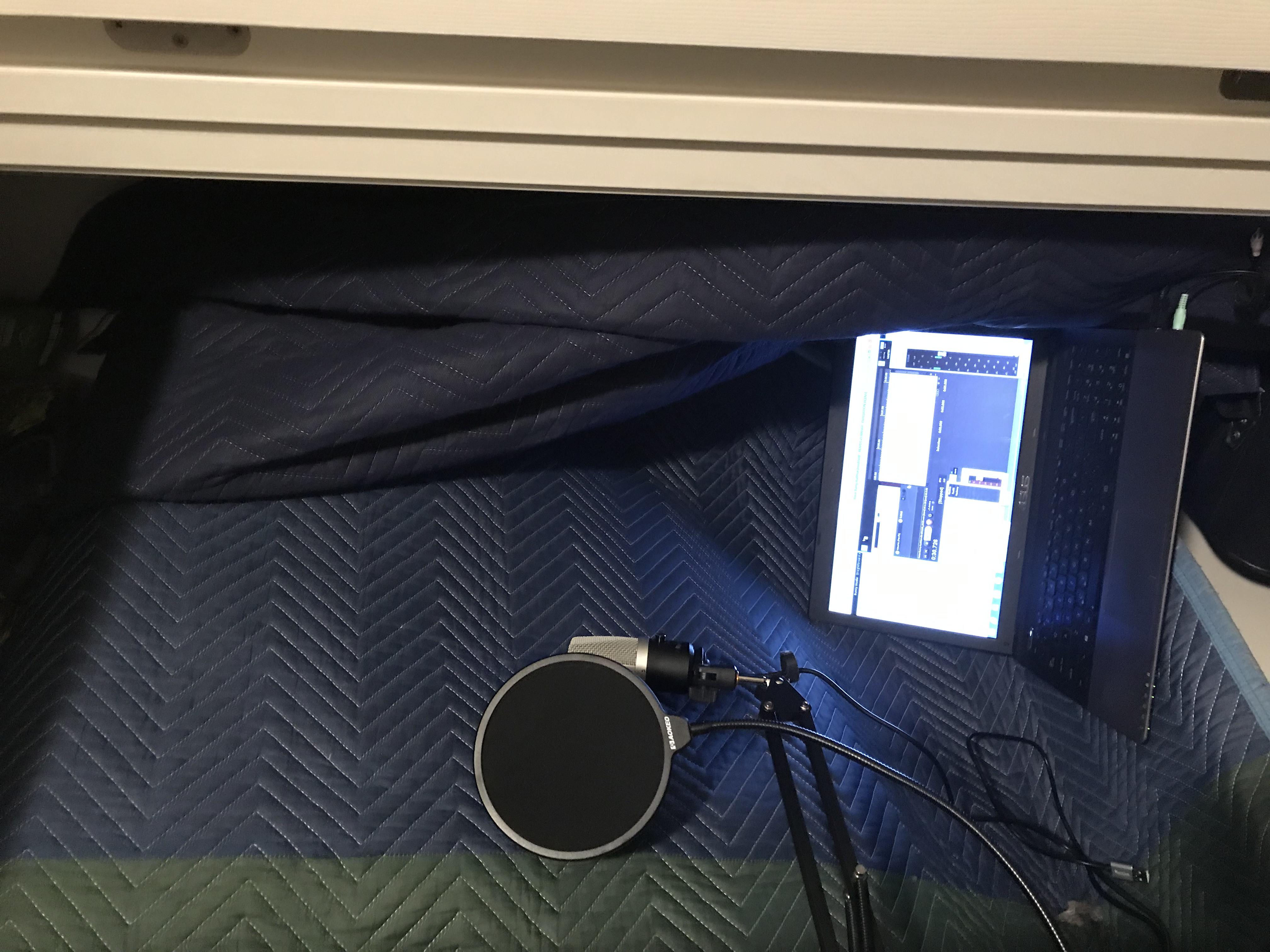
Please sign in to leave a comment.
Bump
Hey, Andy!
Thank you for the super elaborate post, this is just the stuff we need to get you up to par with our accepted talents.
Let me start by saying you have a good voice, but I can hear a nasal quality that probably comes from the way you're enunciating the read, in which you sound a bit serious and deep. This is just a stylistic choice but, it can have a serious impact on the final delivery of your material, so just some food for thought: remember to "feel your voice coming through your nose" as opposed to using your nose to stop the sound... I know this doesn't make a lot of sense when read, but try to do it, I swear it makes a difference. If it helps, you can always google about vocal technique, especially about diaphragmatic speech/intonation. Singers will learn to use the diaphragm and vocalize from the chest to put power and punch behind their voices, without the need of using a 'falsetto' technique, in which the voice reverberates inside the head, which comes in handy for spoken word purposes too.
Now onto the technical stuff... Right out of the bat: that mic won't cut it, not when you're competing with people who work with mics of over $1000 and interfaces of similar price/quality. Now, don't get me wrong: you can perfectly achieve a great sound with an investment of around $500 to include everything you need to record, especially because your space sounds very good already, but that's the next issue. For a microphone, with your space and acoustics, you could benefit from an Audio Technica AT2035 mic, a Behringer 204HD interface, you can even pay the $60 Reaper license and even have some cash left to get a pair of Sony MDR-7506 so that you can hear what we hear. If you still have some spare money, go for more acoustic treatment: buying a mattress top made from memory foam (2" or thicker) will make for an amazing material for sound absorption which you can tailor into custom panels for your space and it's literally 10 times cheaper than buying super expensive 'acoustic foam' that underperforms most of the time.
Back to performance/expertise for a while: you're doing a great job with how you're handling the acquisition of skills in Reaper: it's my most recommended DAW for a good reason. The gate it includes is super precise and my favorite out of purchased and free plugins of the sort, but I can't recommend settings for that until you have a more 'definitive' setup, for they will change if you change your gear. The mouth-click situation is something that many new talents suffer from (and even some seasoned ones too.) The best strategy is to read a lot out loud and listen to yourself. You'll start paying attention to the sounds your mouth makes when enunciating certain words and you must be consciously trying to pinpoint them, so that you may vary/change how you speak to reduce the incidence of these sounds as much as possible from the very source. The second part is with the gate setting: an appropriately set gate will help with those pesky noises, breaths and more, but it's not a silver bullet. Once you've exported a "def" take you'll find some of those sounds still made it in the recording and there's no other way but to manually remove them, through spectral editing for instance or with very careful manual muting of the noisy parts in your speech. Don't worry, you get better at this with time: both at not making the noises and eliminating them faster and better from your reads.
Hopefully, this will help you a bit! Let me know if it did and especially if it didn't, we're happy to help! =)
Cheers!
- Héctor Adolfo Ituarte (VoiceBunny QC Agent)
Hey Hector!
I went to reply to your message once already, but I think my page timed out so I lost all I wanted to say. Ultimately though, I really appreciate your thorough response.
Thank you so much for your feedback! That's exactly what I needed for my critique.
To be honest, I'm a big confused as to what you mean by "feel your voice coming through you nose." I believe this would probably is due to my lack of experience in any choir/drama/acting background. I was able to sort of hear the nasal quality you were referencing, but again, my inexperience is probably one of my barriers to hear what sounds great. I'm taking your cue and listening to videos on proper diaphragmic speaking.
As for the equipment, I've written down your suggestions for future reference. As for now, I'm working with a budget, but I will upgrade later.
I'm glad you're familiar with Reaper, as I have a specific question related to Reaper and a plugin. You said you like the gate that Reaper provides. I had heard a recommendation for beginners to get the Waves NS1 Noise Suppressor and I was wondering if that is even necessary with Reaper's own gate?
Than you for the tip on the mouth clicks. This has been a major frustration after seeing how much it invades most of my speech. I'm taking the time to address it and listen to it according to your tip.
Thanks again Hector, I'm grateful for this feedback!