Sample rejected

Hi there.
New to VB and just had my test sample rejected for
"...1.) Boxiness- There is 'boxiness' impacting your recording which makes it sound as if it was recorded in a very small space. Please ensure you record in an acoustically treated environment. If you already have acoustic treatment, it may not be adequate.
You'll find tips on acoustic treatment on our community page: https://bit.ly/2MrNsSV.
2.) Compression- Your recording is heavily compressed and/or limited. It's affecting the dynamics and quality of the audio. Instead, please raise the volume via automation or normalization to -3dBFS peak.
3.) Hiss/White noise- There is a noticeable level of white noise/hiss impacting your recording that is adversely affecting the quality of the deliverable...."
It was recorded in the space I've recorded audiobooks for ACX, using the Rode mic I use for ACX and wasn't processed in any way apart from level to -3.1dB.
What's the deal? Have a listen and see what you think.
https://www.dropbox.com/s/fbw9158ivlpglby/voicebunnyaudition.wav?dl=0
Please sign in to leave a comment.
I've just resubmitted the same file and it was rejected again, but this time for only TWO of the three things it was rejected for initially. I know there seems to be a lot of people who do well here but from where I'm sitting it seems like a joke.
Anyone from VB want to explain this?
Further to this and in case anyone else reads, you seem to have three opportunities to resubmit before your application is rejected. Interestingly, my second file upload was EXACTLY THE SAME FILE AS THE FIRST SUBMISSION.
This was rejected WITH LESS FAULTS THAN THE FIRST. (2 as opposed to 3, the second submission didn't mention white noise)
Forgive CAPS, I'm not shouting, just emphasising that the processes behind submission listening seems to be somewhat flawed. Does anyone from VB have anything to chip in with on this, please?
Hi, Ray!
Thank you very much for joining our community! We appreciate your interest in the causes of rejection for your application project. I'll be glad to analyze your case and help you in any and every way possible =)
I'll be working on the project and the audio during the day and will come back to you with an educated answer to these quandaries. Thanks in advance for all your patience!
Cheers!
- Héctor Adolfo Ituarte (Bunny Studio QC Agent)
Hello, Hector.
Maria should have briefed you as to the situation. I'm particularly interested in the mentions of 'white noise' and 'compression'. My analysis tools give me a peak value of -3.0 db and the file submitted for the third attempt (also rejected) had a value of -3.1 dB, both have a RMS value of -18 dB approx, noise floor in the region of -70 dB. Neither file has any white noise, boxiness or compression artefacts. I'm also interested as to why my second submission - of the exact same file, it was just reuploaded - was also rejected but this time for two factors instead of three the first time.
Interesting that you got three chances to submit before being rejected as I only had two chances.
I posted on here for comment by QC on Saturday and am still awaiting a response.
Hello, Bill. It certainly seems to be problematic for new signups here, doesn't it? I'm sorry you got rejected too. I assume you know what you're doing and your setup is more than capable as well.
Can you post a link to your submission, or the community post here? I'd really like to hear it myself. And I *assume* it's three attempts; my third submission was knocked back almost immediately. Can I ask, have you listened to my linked clip and if you have, does it sound like a QC reject to you? I really need an outside ear on this, I've produced material for other third parties using the same set up for the last year with no trouble at all.
Cheers!
Here’s my post
https://help.bunnystudio.com/hc/en-us/community/posts/360010238579-Seeking-clarity-on-rejection
I’m not anywhere that I can listen to yours right now but I’ll have a listen as soon as I can.
Bill
Much obliged, Bill. Listened and commented upon on the original thread. I forgot to say in the last post that five days without a response from *anyone* is very poor indeed. As Hector seems to be dealing with me, let's throw it over to him; does he think five days plus is an acceptable time for someone to wait for guidance on their submission?
With regards your files, all I'll say here is that I've worked in broadcast for twenty years (8 in news, 3 in post, the rest my own prod and distribution work) and I wouldn't fail them; also your kit is more than capable for the task. Me? I'm using a Rode NT-1 and AI-1 into my own Mac, not something out of a cracker. I'm sure you've read the rest of this thread, but the most interesting thing I find is that my second rejection was just a reupload of the first file as in my opinion there was nothing wrong with it technically and I didn't have time for a re-rec. It was rejected again but the second time for **less reasons than the first!**.
Overall I'm left with the impression that the QC and feedback process is somewhat arbitrary, no offence to those involved. I hope Hector can also clear up what that double rejection means in terms of the abilities of the people who are QCing these as I am _told_ that a human ear says yes or no, even though other organisations (Amazon) automate the process and to be honest I would expect that to be the case here, makes more sense to me. Especially when one considers the volume of submissions - the ones that post here are only the rejects don't forget - or else QCers ears must be red hot.
Ooh, nice delivery on yours, by the way!
Hi Ray,
got a chance to listen to yours at last. Can’t hear any issues with it at all. No echoes or “boxiness” and didn’t sound overly compressed at all.
Thank you so much for that, Bill. Funnily enough, I thought as much myself. Just so I'm clear and to cover all the points in my initial post, did you hear any white noise?
Ray, there was a *very* slight hiss during silences. I checked it in Izotope RX8 and it was below -60dB so that puts the file squarely within VB’s specs.
As expected, and thank you so very much, Bill. Noise floor on the recording linked above comes out at -71.5 dB using my analysis tools, and that would have been lower if I'd used an expander. But as you so rightly say, squarely within the specs that submitted files should meet with zero processing.
So, Hector what do you have to bring to this?
Ray,
re the item that you suggested. I wasn’t aware of it but now that I am I shall look into it.
you got that from earlier? I see it's somehow disappeared.
Yep, I’m guessing someone to exception to it.
you've got a new follower
I'm never on linkedin but connected there too, because, y'know, connections.
Hi, gents!
It's great to see such friendly banter and enriching exchange between pros, thanks for making good use of this Community!
Please forgive my tardiness, as I've been battling a slight cold these past couple of days. Let's dig in, shall we? I'll take care of Ray's quandaries in this opportunity, but will also be looking at Bill's comments in his own post, so stay tuned for that.
Let's try to make this as succinct as possible, for the sake of clarity. Flatly stated, the rejection is valid for the points given in each of the three different revisions. In that regard, let me apologize for what may seem like conflicting information. In fact, our mistake as QC Team began with asking for as many revisions, when the right to do would have been to reject after the first one if the issues were not corrected to comply with our quality policy. Measures have been taken and this won't happen again, thanks for bringing it to our attention!
As for the different observations, they can be condensed into:
1) Room Echo - Incorrect acoustic balance of the recording space, audible as 'boxiness' (and I would've added a bit of muddiness/boominess too).
2) Hiss - Audible white noise is indeed present throughout the recording, in such a wide frequency spectrum that it's not completely removable from the deliverable.
3) Compression - A more accurate language choice would've been 'dynamics processing', because the shape of the waveform (flat, squared) indicates that either or all of the following might have been applied to the recording: compression, limiting, or RMS Normalization. This is also an audible phenomenon, as harmonic distortion and certain artifacts (such as enhances sibilants) are plainly present throughout the recording.
As a bonus, I would've added 'Processing', as a spectral analysis shows certain dips in specific frequency ranges, that coincide with typical applications of NR/NS processes.
Let's see how these are all identified:
1) Room Echo - While it may not be something one can see in spectral analysis, it's very present and indicates that the acoustic treatment/mic placement is not ideal. I too work with an NT1 inside a closet filled with no fancy stuff (just high-density foams used for mattress fabrication) and winter clothes.This is how it sounds.
2) Hiss - The true noise floor sits @ ~-57.64 dB, as demonstrated by simple amplitude analysis, which validates the audible/perceivable noise level. This is also visible in spectral analysis.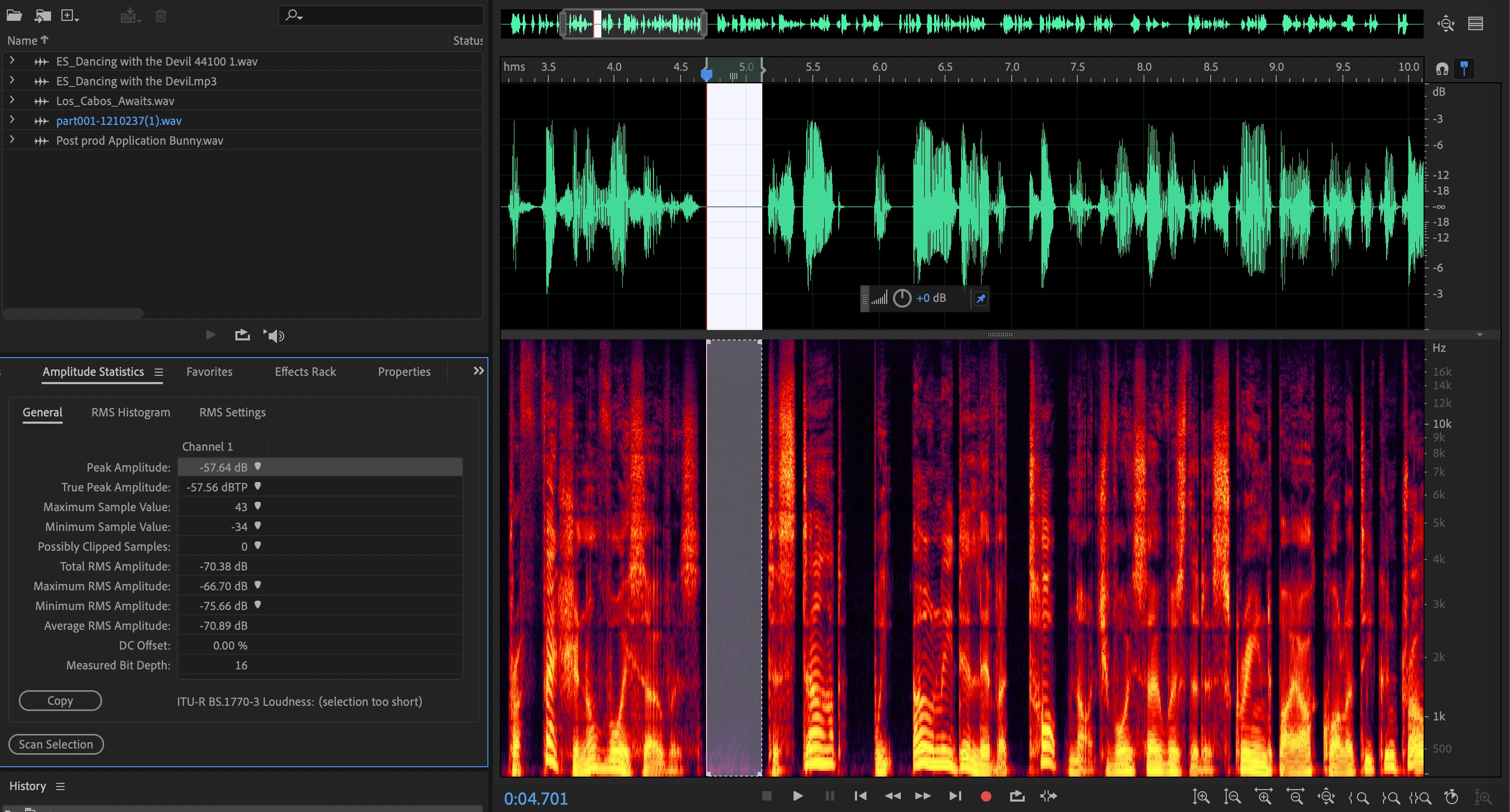
3) Dynamics Processing - Demonstrated by the waveform's shape. Flat bottom/top is indicative of the aforementioned processes (compression, limiting, RMS Normalization, etc.)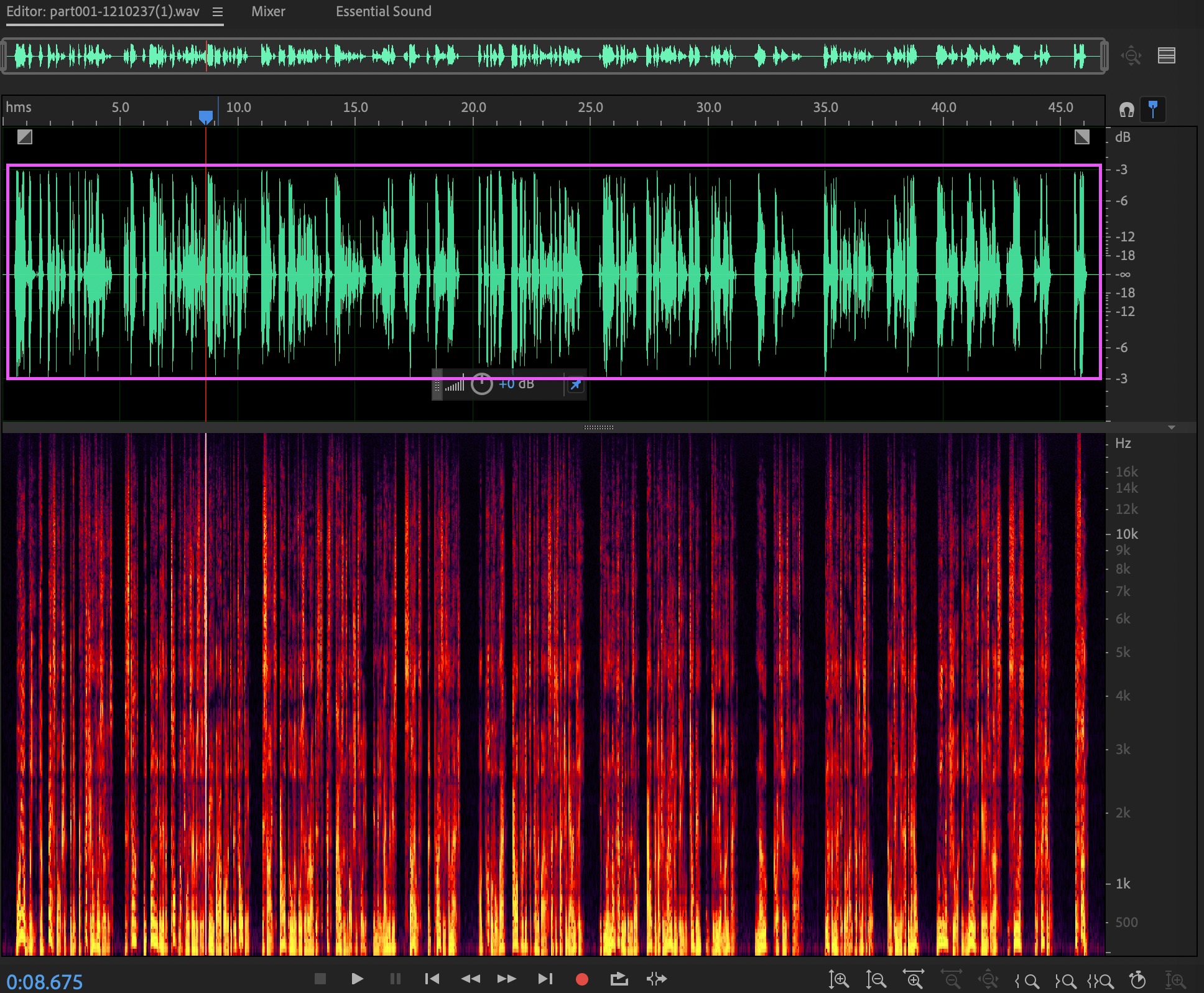
4) NR/NS - A kind of subtractive EQ or similar NR/NS equivalent process might've been used as shown by the blanks present in certain frequency ranges.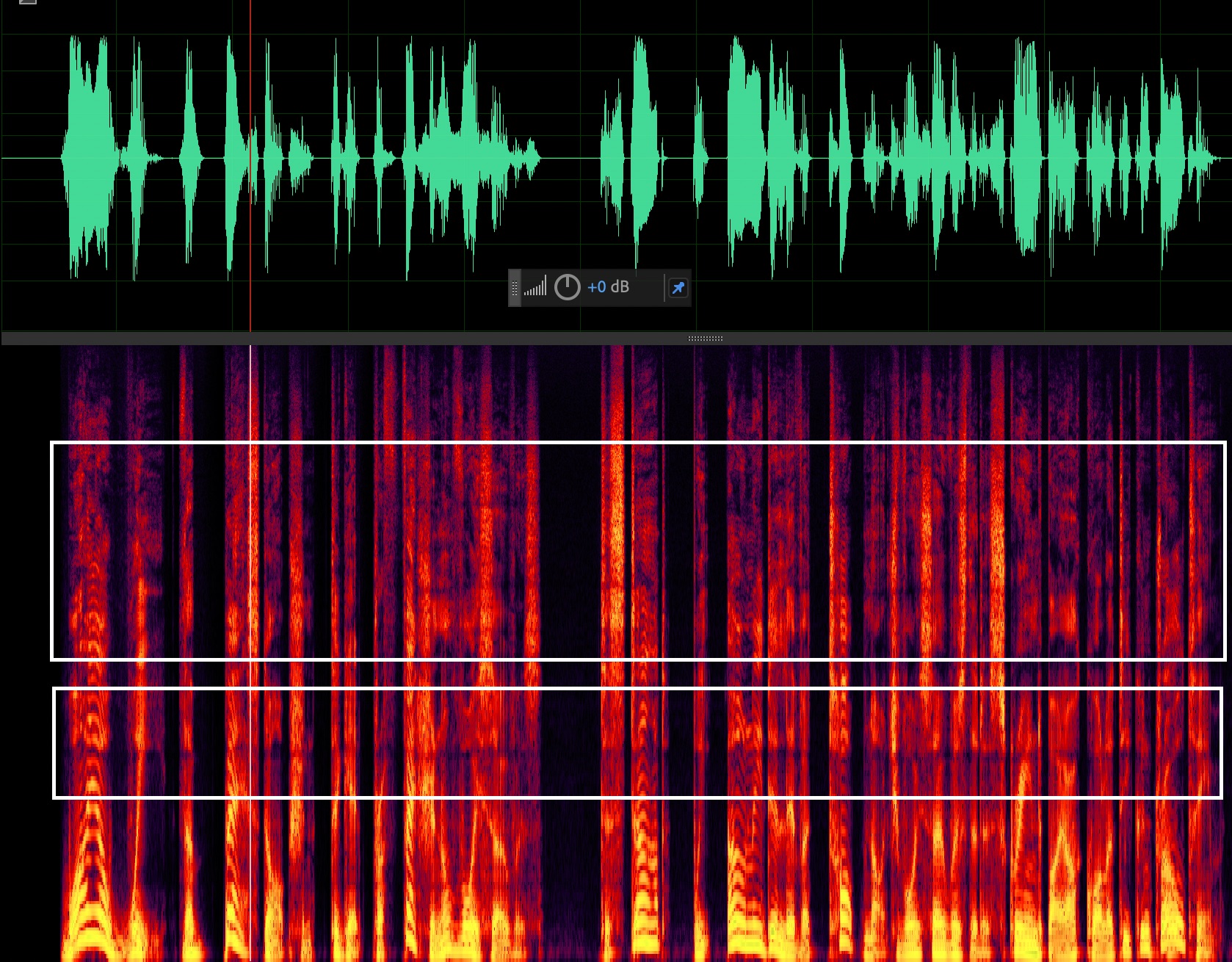
While this rendition of your audio is a better example of what it would sound like with some corrections to the pointed issues, it's still not something that would pass the test, but useful as a benchmark for the time being. I'd love to help you out with that sound, as you have the gear, the pipes, the feeling for the reading, and clearly, you're motivated to figure out stuff like this. If you're interested in doing so, please include the following in your next post:
1) Clear pictures of y our recording environment. Don't be shy, this helps a lot to figure out how to reduce the boxiness.
2) A picture or the readouts of your tracking gain settings (the level used in your preamp/interface.
3) A clean, raw, unprocessed sample at the highest quality your gear will render.
4) A screengrab of your FX chain/settings.
Hopefully, all this brings a bit of clarity! Please let me know if I can be of help to you in any other way =)
Cheers!
- Héctor Adolfo Ituarte (Bunny Studio QC Agent)
Okay then, Hector, strap in because this is a big one just for you.
Firstly, hope you're feeling better, and thank you for that in depth QC breakdown and for clearing up conflicts of information; that explains a lot. And in a roundabout way, glad to be of help! Now, as I've got little else to do today, I've had sip of coffee and a smoke and climbed back into my pram and in order to assess the viability of this as a whole and indeed, to take some tips on board - you can never have too much advice - I've revised a few things about my recording environment; I as mentioned elsewhere I have a naturally quite low and somewhat 'boomy' register and in this case seems to be part of the problem.
But you say you want to help so, yes, let's dig into this. To take your QC points in turn:
Room echo: My space is somewhat - I assume - like yours, a 9' x 6' x 4' closet space lined with Ultraflex 25Kg/M3 foam with an alpha of 0.75 and fabrics covering other reflective spaces. Now that alpha is just nudging the top end for acoustics, but we're not operating from a sound studio here; you and I are in closets, let's not forget! But as mentioned before material has been successfully produced in this space with this insulation before now, so from my point of view the sound absorption is adequate. If you disagree or have alternative suggestions do let me know, but remember things now are not as they were when it was easy just to pop to the foam shop. Money and availability of equipment are in shorter supply than they were and so there's a element of make do in all this. On the point of muddiness, in my experience that indicates incorrect microphone position, so in a space of the above dimensions, what would in your opinion be a good mic position, both within the space and distance from the speaker?
On the point of harmonics and resonance, as you know the NT1 comes with it's own metal pop shield. I have found on some occasions that MY OWN voice can cause harmonics with the included pop shield. So for any linked tests later it's both used and removed - so let's see if that takes care of the harmonics you speak of. I hope the timbre of my voice won't be used against me here, as I'm always going to be at a disadvantage if so. That being said, if - and as I say, I have heard certain resonance in the past - you have any advice for a quick EQ fix that would also be much obliged.
Without a doubt, your sample DOES sound better than mine, for sure. Your noise floor sits at -90dB. With the best will in the world, I refuse to believe that's something recorded inside a cupboard. Simply not possible. What have you done to get it that low? A touch of expansion? NR?
Hiss/Dynamics: best to deal with these in one go, yes amplitude analysis of a quiet spot does indeed give a floor of -59dB, however using my analysis tools for audiobook mastering, I can see that the floor value is closer to -70dB, see?
And that's what I worked to. Now if that tool *averages* values to give a pass then fair enough, but you can see how one can be inclined to believe what analysis tools tell you, especially if they are ones used for other mastering projects. So chalk that up to habit.
To that end, as I keep my levels low and my mic close and that in this case I think works to my disadvantage. VB file submissions are to peak at -3dB. Usually I work to peak at -3.5dB. So I limit UP to bring levels to submission spec. This in turn pushes the floor up... which gives us the white noise issue.
Noise reduction/suppression - Now, hand on heart, no noise reduction or suppression was used. I do see the hole in the waveform at 1.5K or thereabouts in your bottom screencaps and one could say that there's a notch there for sure. It had me scratching my head as I know I didn't apply any filter at that freq. Then I looked at the ORIGINAL PROJECT FILE, before editing or anything else. Look at the spectrograph trace. That is present in the original recording. So what do you think is the cause of that?
That's something I'd be very interested to know as I legitimately have no clue.
Now, pictures. Since we've got into this I've pulled my space apart and rearranged some things so now we're looking like this; Normally I prefer to be facing the Ultraflex wall on the right but to increase my distances for these tests I've angled myself into the corner. A few pictures from outside the space showing the height and a blurry panorama to show you how it fits together. Do bear in mind I AM shy.
So that's where we are right now. I'm going to fiddle about with things here and provide another set of recordings in this revised environment but whilst I'm doing that, let me know:
a) your thoughts on my responses and
b) exactly what you did to get the floor of your recording down to -90 because as I say short of being in a studio OR applying some sort of processing it's simply not possible from a closet - and unless I've misunderstood something key, processing is very much frowned upon. So to assist me, perhaps outline your production chain, mic distance and position and so on - give me a ballpark idea of what's good and bad?
...Or is a little expansion on the file allowed? Lemme know.
To that end, pics of FX chains* and record level setting on my interface will follow in posts with audio. I don't want to swamp this one, so let's take it bit by bit.
*however, your mention of processing chains does suggest to me that I've been loading the dice against myself if unobtrusive file processing aside from gain normalisation IS permitted for submitted files, after all isn't the goal of offering a voice deliverable to have it sound as natural as possible, and we both know that means no or VERY minimal processing...
I appreciate your engagement with me on this, and I trust that you're finding this exchange pleasant. On that note, thanks also for saying that you see where I'm coming from on this. And I won't disagree with you; I do have the gear, the pipes (cute) and an ability to feel the read that I'm dealing with for each job - that's why I applied to be a pro here in the first place, so let's you and me work through the issues that you've highlighted to see if that's going to happen, eh?
Looking forward to your replies and then we can look at and listen to some new files.
Cheers! R
Hi, Ray!
Sorry for taking a bit to answer this, I wanted to take the time to analyze every word and sound in as much detail as possible. I'm left here wishing I could hear that original, raw, recording (as I'm left only with your rejected one). The present processes on those leave me with few options to analyze and fiddle within the box, in the search of a pre-vetted process-oriented solution to the audio quandaries at hand. Let's dive into this then!
Firstly, let's talk about room echo/mic-positioning/acoustics in general. I see those foams lining the walls of your closet. Mine is even smaller! (Please stay tuned for pictures on this). I have used these kinds of foams but have figured out that their best performance is as a 'finishing' foam, that takes care of some frequency breakdown, but not really mitigate reflections completely. Now, apart from properly built booths that naturally take a lot of money to acquire/configure, I'm not sure that completely anechoic spaces are attainable at home on our 'shoestring' budgets, so to speak. What I've found though, is that the need for solutions has left me with some guerrilla-soundproofing techniques. Here's what I'd suggest you do:
1) If your budget/resources/situation allows, I'd build a PVC structure to reduce the height/volume to treat. This ideally would be around 12 to 18 inches tall (two to three acoustics panels in height). The ideal shape in how your room is configured, would either be just a 90º angle (so that it can rest against the corner in which your mic appears in the pics) or a three-panel shape with angles at around 45º to 60º, to rest against the wall farthest from the door. The 'ceiling' for the structure can be just a simple lining made out of blankets/towels/or any reclaimed heavy fabric to which you can then pin/attach your foam panels. For the 'walls' of this proposed structure, I'd do this: Use a high diameter pipe, such as 4". Use some panels attached at either end of the pipe's diameter, lining the space between them with reclaimed heavy fabrics as well (old t-shirts, towels... you get the idea). While one's mileage may vary, the idea behind this is to produce a dry (even if boomy) audio, for it's easier to cut the sub-100 Hz rumble, that to take care of pesky reflections. This works especially well with the NT1's frequency response, as it has a 'shiny' +5 kHz signature, and using a mild to mildly-aggressive low-cut/high-pass processing can yield a full sound still.
2) Another route to go is to use something like memory foam (which can be purchased on the cheap on Amazon for instance) and cutting it to size, to use as an additional lining between the walls and panels, focusing on those immediately adjacent to the mic. An alternative to this is building wooden frames to fill with any old fabric lying around (or acoustic insulation if budget/availability allows). On the subject of memory foam, I've used it and it works amazing, as does any reclaimed fabrics.
As for noise floor/hiss, my insights are kind of a mixed bag. The NT 1 is super quiet when captured with the right interface (I work with a cheap Behringer U-Phoria 404HD) at a low tracking gain level (mine peaks at around -9 dB). You wouldn't guess that my audio gets recorded into an iPad (using Auria) at 48K/24b. I render the recording completely raw into a Dropbox folder, then use Reaper to process it. Here's a cool comparison of raw vs. processed so that you can hear what goes on behind the scenes. I'd really recommend you ditching Audacity and switching to Reaper and/or Audition. The first I love because it's powerful, inexpensive, ultra-customizable, transparent and it comes loaded with a variety of stock plugins that can rival or beat expensive third-party options for what we as VO crafters need. Audition I love for its native spectral editing capabilities and again, some of its stock processes and options like scripting/macro recording which just make one's workflow a helluva lot easier and faster.
I'm not keen on how Audacity processes and renders audio, especially some of its presets like the 'ACX' ones which quite frankly sound like garbage. I know our own site tells people to use it for something simple like Peak Level Normalization, but I really friggin' hate it. Plain and simple.
Once I hear your raw recording, I can tailor a pre-vetted chain with very little, unobtrusive processing for you. For the noise floor thing, my tried and true, the most reliable technique is to apply gentle noise-gating at a threshold of around 38 to 33 dB, with the quickest attack/release settings, plus a stock low-cut filter at around 70 to 90 Hz. Then, when rendering/bouncing (if the DAW requires/allows) I'll use triangular-shaped dithering if downsampling to 44.1/16b (as I tend to capture in 48/24b). I stay away from 96/192K when tracking because that added dynamic range has played against me when trying to smooth out a boomy recording or sharp sibilants. It also makes processing much more of a fine-tuning affair for which I no longer have the time or patience.
Again, all of which I'm suggesting may or may not apply verbatim depending on how your raw sample sounds like. =)
Now, let's keep talking about processing. It is indeed frowned upon in our platform for two main reasons: first, it's really hard to standardize a processing chain when we have over 40,000 pros working with as many mics/home setups, and because most of the audios submitted for paying customers will be worked on by an engineer/mixer down the line. Having said that, we acknowledge that 99% of pros fiddle with their audios in one way or another, and this might be fine, so long as the processing is not a blatant example for compression/limiting or face-melting EQ curves. The reason for which we recommend peak level (vs.RMS) normalization, is that PL won't mess with the dynamics beyond amplification. RMS can and will produce a saturated, clipped, noisy signal in most cases and will render the audio unusable for our platform's purposes.
The same thing happens with compression/limiting. I know it's more comfortable to use a process instead of doing a manual edit, but it just doesn't work as well. By using manual leveling/automation, a pro can even/smooth out a waveform without compromising the dynamics or unnecessarily raising the noise floor in their recording.
To wrap up on the white noise/noise floor issue, I trust my ears more than a meter. If my standard-issue Sony MDR 7506s relay white noise into my earholes, I know I'll find it in the spectrogram too, whether it is the mic's or interface's self-noise or something caused by processing.
So, my dear friend. What do you say we try and keep it simple? Please, let me have your raw audio and I promise to work on it to the best of my abilities. =)
Cheers!
Hola, Hector!
I haven't forgotten you or the things we have been discussing, as I explained to Maria the other day, some grown-up stuff always gets in the way. I've got lots to share with you; just messaging now to keep things warm.
Well, hello again, Hector!
I do hope you’re well. Firstly, my sincere apologies that it's taken so long to get back to you, but that’s the way of things really. Had a lot of (too much) grown-up stuff to do and two other jobs surfaced from nowhere so they needed taking care of. At the same time as that, with a view to your suggestions from your last post, I pulled my space apart and put it back together which took time itself. Not so much as getting my teeth into it; circumstance only gave me a series of nibbles.
So to chew this down with you now, let’s go over the key points in your post, space and processing/DAW thoughts and I’ll include some links to raw and processed audio files for your consideration.
Space
Thanks for your tips. Taking them on board I lowered the fabric ceiling of the space by two and a half feet and rather than use piping, I built two layered panels from some old furniture remnants. The cavity between the layers was stuffed with some old clothing to really deaden the space then used foam to finish. You can see all that here. I really wish there was a way to edit image file sizes.
These were originally balanced under a ‘lid’, but even though my noise floor was consistently lower using this setup it wan’t really very comfortable for long periods of narration work so suspended the lid and mounted one panel to the door of the closet itself and tabletopping the mic. Lots of nice, non-9- degree angles. I also constructed further deadening with two cages and duvets that i physically mounted to either side of the internal door in the closet.
Audio recorded in this environment is comfortably noise floored at -50/54 dB and with gating I can output final audio lower (in my processed sample below I have -66dB) with peaks comfortably around -6/5.5, which is a marked improvement on audio recorded in the earlier configuration, and frankly a pleasant surprise, but you can hear for yourself. I’m actually really happy with how the raw audio and produced clip sound, you're not wrong - when it's set up well the NT1 is very very quiet.
In all truth, I think I could takes levels DOWN a little...
Dig in and see if it can be better for me though.
I did have a look for the original audio for my original submission two(!) months back and in fact I found it, but frankly it’s embarrassing to listen back to now, especially when only a few changes in space and position can produce something a thousand times better! So it serves no purpose to submit to you again
Processing
Okay, you don’t like Audacity. Horses for courses. For instance I won’t go near Audition as I don’t believe in the Adobe subscription model. I have had a look a Reaper but had limited time to actually *use* it, so for now, I’ll be referring to proc chains in Audacity, but - unless I’m wrong - the logical thing to say is if the audio is recorded close to required submission parameters than it would require only minimal processing through any DAW. I see from other posts on here where you have dealt with Audacity users, you concentrate on the audio going in rather than the processing audacity offers, and this assertion follows that logic. So if we’re looking at maybe only a little expansion or noise gating then the DAW that provides that processing polish is academic if one is after as raw as possible for submission.
Obviously, all VB pros will have different levels of proficiency with DAWs depending on their experience, and as I’ve said before I have a lot of experience in live broadcast and production, but skillsets like that are not relevant here, when it currently comes to pro audio production - I’m, let’s say, a talented amateur. The refinements needed for pro audio are VERY exacting, and it’s alright to admit that - especially to myself; when you’re used to years of run-and-gun shooting and making sure things get to air, baby steps are still okay.
I used Soundtrack Pro way back in the day but obviously Audacity is my current go-to for my audio tweaks. As I say, Reaper does look versatile, but believe it or not, Audacity has some plugin functionality that Reaper does not, if my reading of Reaper documentation is correct. Punch pasting recorded room tone over different lengths, for instance. I think one can set up a chain to do that in Reaper but it is complicated, with Audacity there’s a no fuss plugin, simpler and easier for me right now.
I think it’s more to do with what each application DOES to the file, isn’t it? For instance I know Audacity is a destructive editor and Reaper isn’t. I’d love to get into a further discussion with you about the pros and cons of each DAW because you simply know much more about each. I mean you record to an iPad, I think that’s really cool and must be great in terms of space and portability. But - technical question - how do you power your Behringer? I assume a lightning to USB converter to a powered hub? Possibilities are endless when you think about it!
Anyway for now, let’s concentrate on my audio through Audacity. My RX chain is Rode NT1 to Rode AI-1 (set to levels in pic) to MacBook Air and after recording, the editing/processing chain I’m using (and if the environment stays the same can be applied universally) is:
(the breaths, the clicks, etc - I do find that on some ‘C’s, ‘’K’s ‘G’s, - check the hard ‘G’ in ‘give’ in the raw for instance - I click to an extent that i need to chop the offending spike form the waveform, maybe you can tell me why that is, and sometimes I see my waveforms look quite jaggy when I zoom right in, I assume that’s Ana to Digi conversion artefacts? You’ll see and hear that on the raw audio. Do you know? Can you tell me?)
(I do get the difference between RMS v Peak normalisation, after all the audio we’re recording here will be used for things of a higher quality than audiobooks, went with -50 as that was recommended by the gate when checking noise levels)
No EQ apart from a sub-100hz filter curve just to catch low rumbles. And I've left it at that, but you may disagree, in fact I kinda want you to so I can see what I might be missing for VB submission, you get me?
File 1 - raw audio just for you
File 2 - raw audio edited to remove extra noises, repetition, etc.
File 3 - that edit processed (peak normalisation to -3.0, noise gate @ -52dB, -10dB level reduction, att/dec 10ms, low roll off)
Please by all means take the second file (no point editing down the first one) and see what you can to with it to match or better what I have done and _tell me what you do_. When I have the time I will dig around inside Reaper and see what’s what and how it compares.
As a side note, my original brief for the read was to be salesman-like and enthusiastic, you might not think I sound that way in this read, but hey, we’re just testing at the moment. It’s not hard to sound excited when I have to - like maybe when I have to resubmit.
…and on the subject of recording spaces, you still owe me pics of yours.
Get back to me; let me know what I've done, if it now meets submission criteria and where we go from here. After all, like you said, I’ve got the intent and the pipes, so let's get me the best I can be.
Cheers!
Hello, Ray!
I'm going to keep this short and sweet, and save the thread as a complete success because all I have to say is: WOW! Mate, you killed it!
Your work in improving the echoic conditions of your space is so good and miles ahead of what it was when we first began this exchange. I'm pleased for you to hear such clean audio even in the raw sample you attached. I've let my fellow Bunny Managers know that you should be up for reconsideration, so a new application should be getting to you very soon.
Once again, congratulations! If I were to ask you to modify anything of your processing/etc., it'd be unnecessary because I think as long as you keep your gear/processing dialed in this way, you'll be able to deliver audio compliant with Bunny Standards, and furthermore, in a quality that any engineer/producer can work with easily and frictionless. Super kudos!
Thank you once again for the hard work put into your setup. This is the kind of result and interaction that one always aims to get from community threads, and I won't forget it. I'm transitioning to a different position but will continue to lurk around the community, helping my friends and colleagues.
I wish you nothing less than absolute success in our platform! Cheers!
– Héctor Adolfo Ituarte (Bunny Studio QC Agent [2019-2021])
Thanks a lot, Hector! It's nice when effort is rewarded with the result you want. Onward an upward to both of us it seems, good luck to you!
So how long before the new application gets to me? A friend I've met on these boards was left hanging for over a month before he got anywhere with a reapplication... Will the new application require a new read or will it be the same material? Can we just skip that step ;) ?
If you drop back into the boards and get this do please let me know. It's a shame though I guess I'll never get to know about your NT1 to iPad setup now...
All the best to you.
Ray
Hi Ray,
You should receive that new application within the next 30 days.
Please, let us know if you don't so we can make sure you get it.